

Running a company website should bring in leads, not frustration. Yet many small business websites sit on page two or three of search results, invisible to the customers actively looking for their services. The truth is, most ranking problems are not caused by one giant issue. They come from a series of small, avoidable mistakes that quietly pile up over time. Understanding where things go wrong is the first step toward fixing them, and at Next Level Marketing Agency, we help business owners spot these gaps before they cost more traffic and revenue.
Why Small Business Websites Struggle to Rank
Search engines reward websites that are fast, clear, and genuinely useful to visitors. Small business websites often fall behind not because the products or services are weak, but because the website itself sends mixed signals to search engines and visitors alike.
This gap matters most for small business websites, since local competitors are often just a click away in the same search results.
A few common reasons include:
Outdated website structure that confuses crawlers
Content written for search engines instead of real people
No clear strategy for local search visibility
These issues do not just affect rankings. They also change how many people actually click through once your site does appear in results, which is where our SEO and digital marketing services usually start when reviewing a new client site.
It is also worth noting that ranking problems rarely announce themselves clearly. A business owner might notice fewer phone calls or form submissions without realizing the root cause is a handful of overlooked settings on the website itself. That is why a structured review, rather than guesswork, tends to produce far better results.
Common Technical SEO Mistakes
Technical problems are often invisible to the average site owner, but search engines notice them immediately.
Slow Page Speed
A website that takes too long to load loses visitors before they even see the homepage. Search engines track how quickly pages respond, and slow load times often lead to lower rankings and higher bounce rates. Large image files, outdated hosting plans, and unnecessary plugins are usually the culprits.
Missing Mobile Optimization
More than half of web traffic today comes from phones and tablets. If a website is hard to navigate on a small screen, visitors leave quickly, and search engines take note of that behavior. A mobile-friendly layout is no longer optional for small business websites hoping to compete.
Broken Links and Poor Site Structure
Dead links, missing pages, and a confusing menu structure make it harder for both visitors and search engines to find what they need. A clean, logical structure helps every page get discovered and indexed properly.
Missing Technical Basics
A few smaller technical gaps also add up quickly:
No XML sitemap submitted to search engines
Duplicate URLs created by unclear website settings
Missing secure HTTPS setup on older sites
None of these are difficult to fix once identified, but they are easy to overlook without a proper site review.
Weak Core Web Vitals
Search engines also measure how stable and responsive a page feels while it loads, not just how quickly it technically finishes loading. Elements that shift around, buttons that take a moment to respond, or images that appear late can all contribute to a poor user experience. Addressing these details through website performance optimization can improve both search rankings and the amount of time visitors spend on your page.
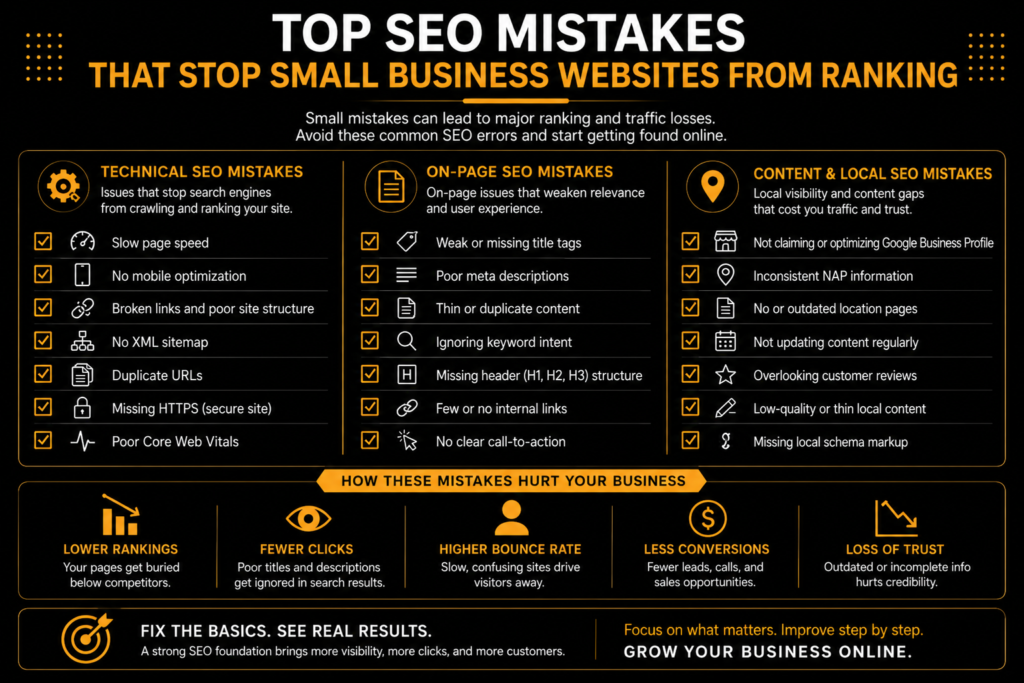
SEO Mistakes Checklist
Before diving into on-page and local SEO details, it helps to see the full picture in one place. The checklist below breaks down the most common mistakes across technical, on-page, and local SEO categories, so you can quickly spot where your own website might be falling short.
 On-Page SEO Mistakes That Hurt Rankings
Once the technical foundation is solid, the next layer to review is what appears directly on each page. This is where many small business websites lose visibility without realizing it.
Weak Title Tags and Meta Descriptions
Every page needs a clear title and description that explain what the page offers. Generic or missing tags make it harder for search engines to match your pages with relevant searches, and they also reduce the chances of someone clicking your listing over a competitor’s.
Thin or Duplicate Content
Pages with very little text, or content copied across multiple pages, give search engines little reason to rank them well. Each page should serve a clear purpose and offer enough detail to genuinely help the reader.
Ignoring Keyword Intent
Using the right words matters, but understanding why someone is searching matters more. A visitor searching for pricing information wants different content than someone researching general advice. Matching content to intent is one of the most overlooked parts of on-page SEO, and it plays a major role in how well a page performs once it starts ranking.
Missing Header Structure and Internal Links
Search engines rely on headers to understand how a page is organized, and visitors rely on them to scan content. Pages without a clear H1, H2, and H3 structure often feel harder to read, which can push visitors away before they find what they need. Internal links between related pages also matter, since they help both visitors and search engines discover more of what a website has to offer, keeping people engaged for longer.
Content and Local SEO Mistakes
For most small businesses, local visibility is where the real opportunity lies. Unfortunately, this is also where many mistakes happen.
Skipping Local SEO
Not claiming or properly optimizing a business profile, missing location pages, and inconsistent business information across directories all weaken local search performance. Customers searching nearby should be able to find accurate details instantly.
Not Updating Content Regularly
Search engines favor websites that show signs of activity. A site that has not been updated in years signals stagnation, while fresh, relevant content shows both visitors and search engines that the business is active and reliable.
Overlooking Customer Reviews
Reviews influence both local rankings and how trustworthy a business appears to new visitors. A steady stream of recent, genuine reviews often makes a noticeable difference in local search results.
Inconsistent Business Information
When a business name, address, or phone number appears differently across various directories and platforms, it creates confusion for both search engines and potential customers. Keeping this information consistent everywhere it appears online is a simple step that strengthens local trust and search visibility over time.
How These Mistakes Affect Click-Through Rate
Ranking is only part of the equation. Even a page that appears on the first result page will not perform well if people scroll past it. This is where click-through rate becomes just as important as ranking position.
Common reasons for low click-through rate include:
Titles that do not clearly state the benefit or offer
Descriptions that feel vague or generic
Missing trust signals like reviews or clear service details
Small adjustments to how a page presents itself in search results can meaningfully change how many people choose to click, without needing a single change to actual ranking position. This is one of the fastest wins available for small business websites, since it often takes far less effort than building new content from scratch.
Overlooked Rich Snippet Opportunities
Structured data, star ratings, and other rich snippet elements can make a listing stand out visually against competitors on the same results page. Websites that skip this step often blend into the rest of the list, even when their content is genuinely strong.
How to Fix These Mistakes and Improve Rankings
Fixing these issues does not require rebuilding an entire website overnight. Most improvements can happen gradually with a clear plan.
A simple starting checklist includes:
Run a technical audit to catch speed and mobile issues
Rewrite thin pages with clearer, more helpful information
Update title tags and descriptions to reflect real search intent
Claim and complete local business listings
Set a regular schedule for content updates
Consistency matters more than perfection. Small, steady improvements tend to outperform occasional large overhauls, especially for small business websites competing against larger companies with bigger budgets.
Tracking Progress the Right Way
Fixing mistakes is only half the process. Keeping an eye on organic traffic, keyword positions, and click-through rate over time helps confirm which changes are actually working. Without this kind of tracking, it becomes difficult to know whether recent updates are making a real difference or simply adding more work without a clear return.
Final Thoughts
SEO mistakes are rarely dramatic. They build up slowly through missed details, outdated pages, and content written without a clear purpose. The good news is that every mistake covered here can be corrected with the right plan and steady effort. Small business websites that address these issues consistently tend to see stronger visibility, better engagement, and more qualified traffic over time. Most business owners do not have the time to monitor every technical detail while also running daily operations, and that is a normal part of growing a company. If your website has been underperforming and you are ready for a clear path forward, the team at Next Level Marketing Agency is here to help. Feel free to reach out to our team for a straightforward conversation about where your website currently stands and what improvements would make the biggest difference.